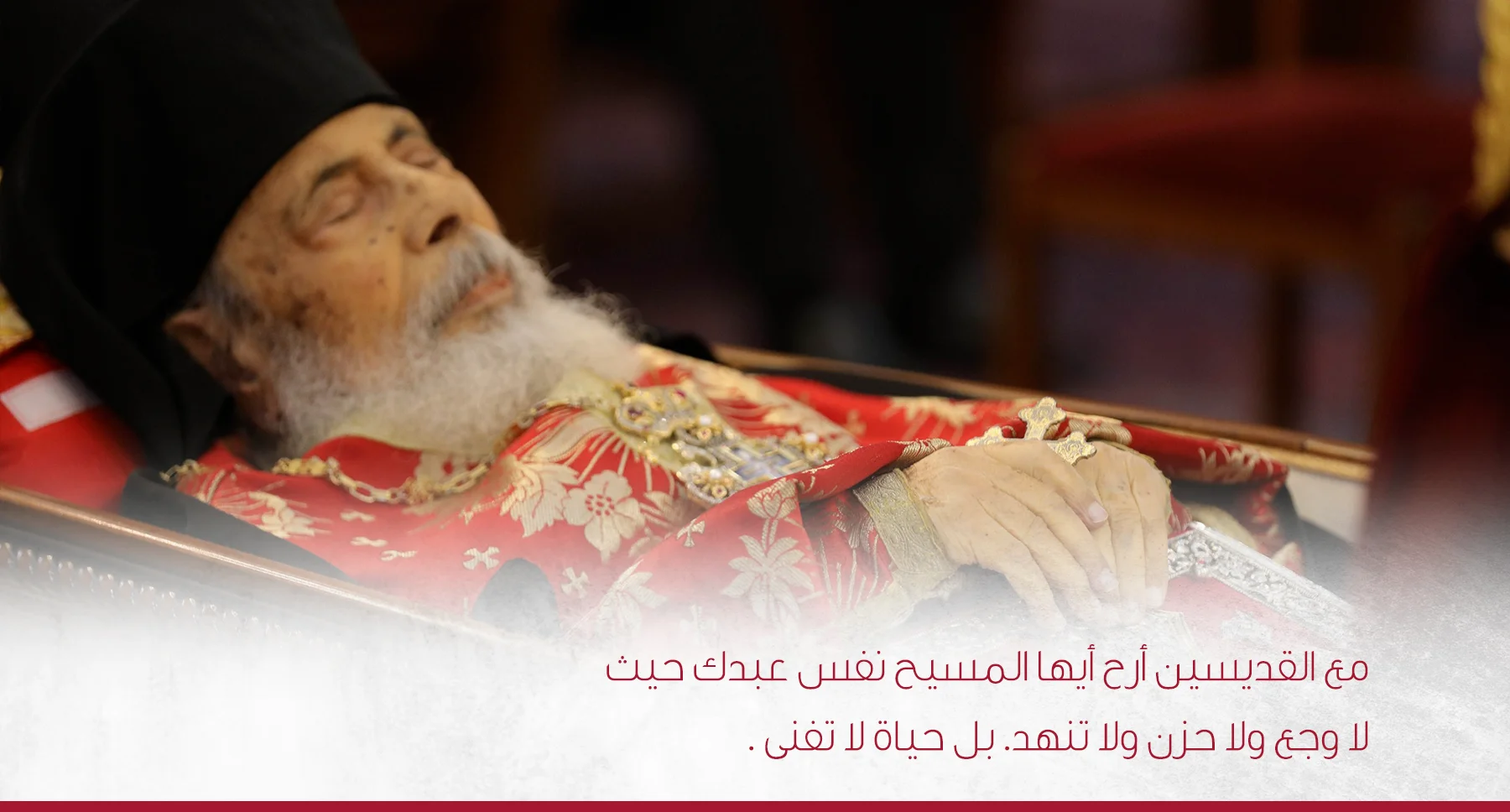

Death is an inevitable reality of human life. Yet many of us do not even wish to discuss it; we would rather forget it or pretend it does not exist. But can we truly forget that we are mortal, that our earthly existence is passing? Human beings are unwilling to surrender to death, and this very resistance bears witness to the truth that we are not destined for death. As the Lord says:
“Jesus said unto her, I am the resurrection, and the life: he that believeth in me, though he were dead, yet shall he live” (John 11:25).
Here, the Lord reveals and affirms the way that leads to immortality, resurrection, and life. He gave Himself as a ransom to overcome the death that held us captive under sin. Through the Cross, He descended into Hades, broke the power of death, and rose on the third day, opening for all humanity the way to rise from the dead. Thus, He became the firstfruits of those who have fallen asleep and the firstborn from the dead. Only those who believe in Him can overcome this barrier; the grave, which is death itself, for there is a resurrection and incorruption.
These two truths are firmly rooted in our Orthodox faith. Those who believe in them possess hope. They may fear death, but they will certainly not despair.
Therefore, it is only the body that dies, decays, and returns to the elements from which it was formed. As for the soul, it departs to the One from whom it received its existence and remains there until the General Resurrection, when it will be clothed with a new, spiritual body. As the Apostle Paul writes:
“It is sown a natural body; it is raised a spiritual body. There is a natural body, and there is a spiritual body” (1 Corinthians 15:44).
In this way, the human person will attain eternal life, of which the Lord Himself says:
“Verily, verily, I say unto you, He that heareth my word, and believeth on him that sent me, hath everlasting life, and shall not come into condemnation; but is passed from death unto life” (John 5:24).
This is the truth: the departed has “passed from death unto life”. Accordingly, the departed person remains a living member of the Body of the living God. The Body of Jesus Christ is the Church, and for this reason the Church consists of two parts: the Church Triumphant, comprising all those who have gone before us in the hope of resurrection and eternal life, and the Church Militant, comprising us, the living members of the Church who continue to live out her life here on earth.
Thus, the Church Fathers teach that there is no death within the Church, the Body of Jesus Christ; rather, there is falling asleep and passing on. Death, in its true sense, is the death caused by sin. Therefore, many of those whom we see among the living are, in truth, dead, while many of those who lie in their graves are, in truth, alive.
In the Church, both the living and those who have fallen asleep remain united, for we are all members of one Body, whose Head is Christ. From this unity arises each person’s responsibility towards the other, particularly the responsibility of the living towards the departed. The highest expression of this duty, and a true manifestation of love and respect for them, is to pray for them.
This is clearly reflected in Holy Scripture. In the Old Testament, for example, we find an account of prayer and offerings for the departed in the Second Book of Maccabees:
“For if he had not hoped that they that were slain should have risen again, it had been superfluous and vain to pray for the dead. And also in that he perceived that there was great favour laid up for those that died godly, it was an holy and good thought. Whereupon he made a reconciliation for the dead, that they might be delivered from sin” (2 Maccabees 12:44–45).
In the New Testament, we also find the Apostle Paul praying for Onesiphorus in his Second Epistle to Timothy:
“The Lord grant unto him that he may find mercy of the Lord in that day” (2 Timothy 1:18).
This passage has traditionally been understood in the Church as a prayer for Onesiphorus, who had fallen asleep in the Lord.
Of course, every person will be judged according to his or her deeds, and there is no repentance after death. Nevertheless, the mercy of God is great, and we cannot fully comprehend His judgements. For this reason, from the earliest centuries of Christianity, our Holy Church has established prayers for the souls of those who have fallen asleep in the Lord. Prayers for the departed are offered, just as prayers are offered for the living, at every Divine Liturgy.
The Apostolic Canons also refer to and encourage prayers for the departed. All the Holy Fathers agree that the soul of the departed finds comfort and benefit through these prayers. Among them are Saint Cyril of Jerusalem, Saint John Chrysostom, Saint John the Merciful, and Saint Macarius.
The Purpose of Praying for the Departed
1. Celebrating Divine Liturgies for the departed: These are offered for the forgiveness of their sins and the repose of their souls, particularly during the first forty days following their repose, and preferably on a regular basis.
Their names should also be commemorated by the priest at the Holy Altar through the offering of commemorative prayers (mnemosyna). At the conclusion of the Divine Liturgy, the priest places the particles on the holy diskos, representing the names of both the living and the departed, into the Holy Chalice, praying that the sins and transgressions of God’s servants may be washed away through His Precious Blood.
2. Funeral services and memorial prayers should be held on the third, ninth, and fortieth days following the repose of the departed, as well as at the six-month and one-year anniversaries, on the two Saturdays of the Departed (the Saturday before Meatfare Sunday and the Saturday before Pentecost), and annually on the anniversary of the departed person’s repose.
It is also preferable for the funeral service to take place immediately after the Divine Liturgy.
Here, we must emphasise that social customs should never be allowed to take precedence over our faith and obedience to the Church, thereby compromising our spiritual lives and the repose of the soul of the departed.
For example, the practice of combining the third-day, ninth-day, and fortieth-day memorial services into a single service should be avoided. It is preferable for each service to be held at its proper time, even if attended by family members only.
Another social practice that is not accepted by the Church is refraining from attending church on the grounds that the family is observing a period of mourning.
Furthermore, food that is not permitted during fasting periods should not be served on fasting days, namely Wednesdays and Fridays throughout the year, as well as during the fasts of Great Lent, the Nativity, the Apostles, and the Dormition of the Mother of God. By doing so, we would be asking the Lord to have mercy on the departed while, at the same time, violating the commandments of the Church.
3. Performing Acts of Charity in Memory of the Departed by supporting charitable institutions and families in need, as well as by publishing prayer books and books containing liturgical services.
Instead of purchasing funeral wreaths, it is preferable to reduce the amount spent on food prepared and distributed as an act of charity (rahmeh) and donate the money saved to charitable causes.
4. We should include prayers for the departed in our daily spiritual rule by reciting the Prayer Rope and asking the Lord to have mercy on their souls, saying:
“Lord Jesus Christ, have mercy on Your servant [Name].”
Or:
“O Most Holy Theotokos, save Your servant [Name].”
We should also attend the funeral and memorial services held for the departed inside the church, rather than those held outside it.


Copyright © 2026 Orthodox Jordan. All rights reserved.